
Configuration#
PyPSA-Eur has several configuration options which are documented in this section and are collected in a config/config.yaml file. This file defines deviations from the default configuration (config/config.default.yaml); confer installation instructions at Handling Configuration Files.
Top-level configuration#
“Private” refers to local, machine-specific settings or data meant for personal use, not to be shared. “Remote” indicates the address of a server used for data exchange, often for clusters and data pushing/pulling.
Unit |
Values |
Description |
|
|---|---|---|---|
version |
– |
0.x.x |
Version of PyPSA-Eur. Descriptive only. |
tutorial |
bool |
{true, false} |
Switch to retrieve the tutorial data set instead of the full data set. |
logging |
|||
– level |
– |
Any of {‘INFO’, ‘WARNING’, ‘ERROR’} |
Restrict console outputs to all infos, warning or errors only |
– format |
– |
Custom format for log messages. See LogRecord attributes. |
|
private |
|||
– keys |
|||
– – entsoe_api |
– |
Optionally specify the ENTSO-E API key. See the guidelines to get ENTSO-E API key |
|
remote |
|||
– ssh |
– |
Optionally specify the SSH of a remote cluster to be synchronized. |
|
– path |
– |
Optionally specify the file path within the remote cluster to be synchronized. |
run#
It is common conduct to analyse energy system optimisation models for multiple scenarios for a variety of reasons, e.g. assessing their sensitivity towards changing the temporal and/or geographical resolution or investigating how investment changes as more ambitious greenhouse-gas emission reduction targets are applied.
The run section is used for running and storing scenarios with different configurations which are not covered by Wildcards. It determines the path at which resources, networks and results are stored. Therefore the user can run different configurations within the same directory. If a run with a non-empty name should use cutouts shared across runs, set shared_cutouts to true.
Unit |
Values |
Description |
|
|---|---|---|---|
name |
– |
str/list |
Specify a name for your run. Results will be stored under this name. If |
prefix |
– |
str |
Prefix for the run name which is used as a top-layer directory name in the results and resources folders. |
scenarios |
|||
– enable |
bool |
{true, false} |
Switch to select whether workflow should generate scenarios based on |
– file |
str |
Path to the scenario yaml file. The scenario file contains config overrides for each scenario. In order to be taken account, |
|
disable_progressbar |
bool |
{true, false} |
Switch to select whether progressbar should be disabled. |
shared_resources |
bool/str |
Switch to select whether resources should be shared across runs. If a string is passed, this is used as a subdirectory name for shared resources. If set to ‘base’, only resources before creating the elec.nc file are shared. |
|
shared_cutouts |
bool |
{true, false} |
Switch to select whether cutouts should be shared across runs. |
foresight#
Unit |
Values |
Description |
|
|---|---|---|---|
foresight |
string |
{overnight, myopic, perfect} |
See Foresight Options for detail explanations. |
Note
If you use myopic or perfect foresight, the planning horizon in The {planning_horizons} wildcard in scenario has to be set.
scenario#
The scenario section is an extraordinary section of the config file
that is strongly connected to the Wildcards and is designed to
facilitate running multiple scenarios through a single command
# for electricity-only studies
snakemake -call solve_elec_networks

# for sector-coupling studies
snakemake -call solve_sector_networks
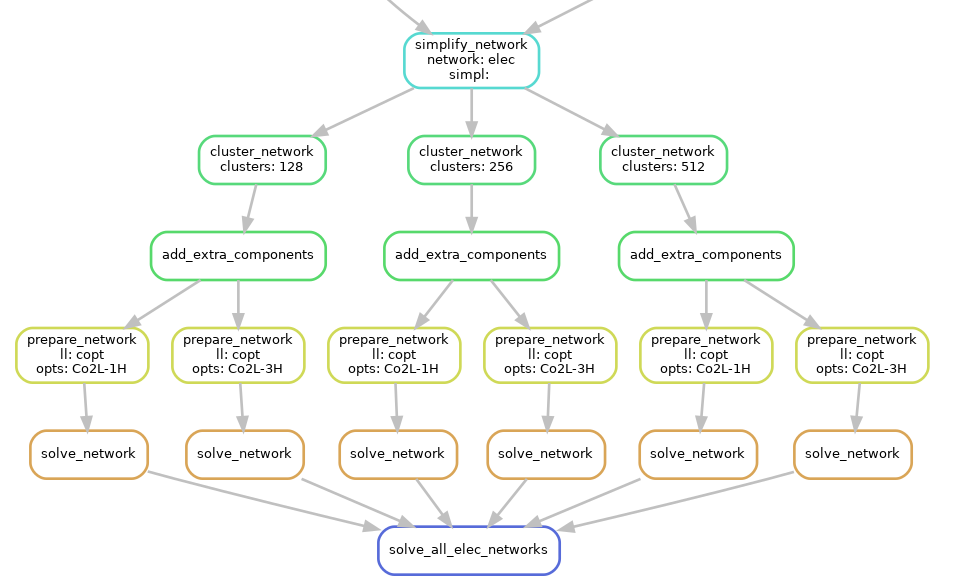
For each wildcard, a list of values is provided. The rule
solve_all_elec_networks will trigger the rules for creating
results/networks/elec_s{simpl}_{clusters}_ec_l{ll}_{opts}.nc for all
combinations of the provided wildcard values as defined by Python’s
itertools.product(…) function
that snakemake’s expand(…) function
uses.
An exemplary dependency graph (starting from the simplification rules) then looks like this:
Unit |
Values |
Description |
|
|---|---|---|---|
simpl |
– |
List of |
|
clusters |
– |
List of |
|
ll |
– |
List of |
|
opts |
– |
List of |
|
sector_opts |
– |
List of |
|
planning_horizons |
– |
List of |
countries#
Unit |
Values |
Description |
|
|---|---|---|---|
countries |
– |
Subset of {‘AL’, ‘AT’, ‘BA’, ‘BE’, ‘BG’, ‘CH’, ‘CZ’, ‘DE’, ‘DK’, ‘EE’, ‘ES’, ‘FI’, ‘FR’, ‘GB’, ‘GR’, ‘HR’, ‘HU’, ‘IE’, ‘IT’, ‘LT’, ‘LU’, ‘LV’, ‘ME’, ‘MK’, ‘NL’, ‘NO’, ‘PL’, ‘PT’, ‘RO’, ‘RS’, ‘SE’, ‘SI’, ‘SK’} |
European countries defined by their Two-letter country codes (ISO 3166-1) which should be included in the energy system model. |
snapshots#
Specifies the temporal range to build an energy system model for as arguments to pandas.date_range
Unit |
Values |
Description |
|
|---|---|---|---|
start |
– |
str or datetime-like; e.g. YYYY-MM-DD |
Left bound of date range |
end |
– |
str or datetime-like; e.g. YYYY-MM-DD |
Right bound of date range |
inclusive |
– |
One of {‘neither’, ‘both’, ‘left’, ‘right’} |
Make the time interval closed to the |
enable#
Switches for some rules and optional features.
Unit |
Values |
Description |
|
|---|---|---|---|
enable |
str or bool |
{auto, true, false} |
Switch to include (true) or exclude (false) the retrieve_* rules of snakemake into the workflow; ‘auto’ sets true|false based on availability of an internet connection to prevent issues with snakemake failing due to lack of internet connection. |
prepare_links_p_nom |
bool |
{true, false} |
Switch to retrieve current HVDC projects from Wikipedia |
retrieve_databundle |
bool |
{true, false} |
Switch to retrieve databundle from zenodo via the rule |
retrieve_sector_databundle |
bool |
{true, false} |
Switch to retrieve sector databundle from zenodo via the rule |
retrieve_cost_data |
bool |
{true, false} |
Switch to retrieve technology cost data from technology-data repository. |
build_cutout |
bool |
{true, false} |
Switch to enable the building of cutouts via the rule |
retrieve_irena |
bool |
{true, false} |
Switch to enable the retrieval of |
retrieve_cutout |
bool |
{true, false} |
Switch to enable the retrieval of cutouts from zenodo with |
build_natura_raster |
bool |
{true, false} |
Switch to enable the creation of the raster |
retrieve_natura_raster |
bool |
{true, false} |
Switch to enable the retrieval of |
custom_busmap |
bool |
{true, false} |
Switch to enable the use of custom busmaps in rule |
drop_leap_day |
bool |
{true, false} |
Switch to drop February 29 from all time-dependent data in leap years |
co2 budget#
Unit |
Values |
Description |
|
|---|---|---|---|
co2_budget |
– |
Dictionary with planning horizons as keys. |
CO2 budget as a fraction of 1990 emissions. Overwritten if |
Note
this parameter is over-ridden if CO2Lx or cb is set in
sector_opts.
electricity#
Unit |
Values |
Description |
|
|---|---|---|---|
voltages |
kV |
Any subset of {220., 300., 380.} |
Voltage levels to consider |
gaslimit_enable |
bool |
true or false |
Add an overall absolute gas limit configured in |
gaslimit |
MWhth |
float or false |
Global gas usage limit |
co2limit_enable |
bool |
true or false |
Add an overall absolute carbon-dioxide emissions limit configured in |
co2limit |
\(t_{CO_2-eq}/a\) |
float |
Cap on total annual system carbon dioxide emissions |
co2base |
\(t_{CO_2-eq}/a\) |
float |
Reference value of total annual system carbon dioxide emissions if relative emission reduction target is specified in |
operational_reserve |
Settings for reserve requirements following GenX |
||
– activate |
bool |
true or false |
Whether to take operational reserve requirements into account during optimisation |
– epsilon_load |
– |
float |
share of total load |
– epsilon_vres |
– |
float |
share of total renewable supply |
– contingency |
MW |
float |
fixed reserve capacity |
max_hours |
|||
– battery |
h |
float |
Maximum state of charge capacity of the battery in terms of hours at full output capacity |
– H2 |
h |
float |
Maximum state of charge capacity of the hydrogen storage in terms of hours at full output capacity |
extendable_carriers |
|||
– Generator |
– |
Any extendable carrier |
Defines existing or non-existing conventional and renewable power plants to be extendable during the optimization. Conventional generators can only be built/expanded where already existent today. If a listed conventional carrier is not included in the |
– StorageUnit |
– |
Any subset of {‘battery’,’H2’} |
Adds extendable storage units (battery and/or hydrogen) at every node/bus after clustering without capacity limits and with zero initial capacity. |
– Store |
– |
Any subset of {‘battery’,’H2’} |
Adds extendable storage units (battery and/or hydrogen) at every node/bus after clustering without capacity limits and with zero initial capacity. |
– Link |
– |
Any subset of {‘H2 pipeline’} |
Adds extendable links (H2 pipelines only) at every connection where there are lines or HVDC links without capacity limits and with zero initial capacity. Hydrogen pipelines require hydrogen storage to be modelled as |
powerplants_filter |
– |
use pandas.query strings here, e.g. |
Filter query for the default powerplant database. |
custom_powerplants |
– |
use pandas.query strings here, e.g. |
Filter query for the custom powerplant database. |
everywhere_powerplants |
– |
Any subset of {nuclear, oil, OCGT, CCGT, coal, lignite, geothermal, biomass} |
List of conventional power plants to add to every node in the model with zero initial capacity. To be used in combination with |
conventional_carriers |
– |
Any subset of {nuclear, oil, OCGT, CCGT, coal, lignite, geothermal, biomass} |
List of conventional power plants to include in the model from |
renewable_carriers |
– |
Any subset of {solar, onwind, offwind-ac, offwind-dc, hydro} |
List of renewable generators to include in the model. |
estimate_renewable_capacities |
|||
– enable |
bool |
Activate routine to estimate renewable capacities in rule |
|
– from_opsd |
– |
bool |
Add renewable capacities from OPSD database. The value is depreciated but still can be used. |
– year |
– |
bool |
Renewable capacities are based on existing capacities reported by IRENA (IRENASTAT) for the specified year |
– expansion_limit |
– |
float or false |
Artificially limit maximum IRENA capacities to a factor. For example, an |
– technology_mapping |
Mapping between PyPSA-Eur and powerplantmatching technology names |
||
– – Offshore |
– |
Any subset of {offwind-ac, offwind-dc} |
List of PyPSA-Eur carriers that is considered as (IRENA, OPSD) onshore technology. |
– – Offshore |
– |
{onwind} |
List of PyPSA-Eur carriers that is considered as (IRENA, OPSD) offshore technology. |
– – PV |
– |
{solar} |
List of PyPSA-Eur carriers that is considered as (IRENA, OPSD) PV technology. |
autarky |
|||
– enable |
bool |
true or false |
Require each node to be autarkic by removing all lines and links. |
– by_country |
bool |
true or false |
Require each country to be autarkic by removing all cross-border lines and links. |
atlite#
Define and specify the atlite.Cutout used for calculating renewable potentials and time-series. All options except for features are directly used as cutout parameters.
Unit |
Values |
Description |
|
|---|---|---|---|
default_cutout |
– |
str |
Defines a default cutout. |
nprocesses |
– |
int |
Number of parallel processes in cutout preparation |
show_progress |
bool |
true/false |
Whether progressbar for atlite conversion processes should be shown. False saves time. |
cutouts |
|||
– {name} |
– |
Convention is to name cutouts like |
Name of the cutout netcdf file. The user may specify multiple cutouts under configuration |
– – module |
– |
Subset of {‘era5’,’sarah’} |
Source of the reanalysis weather dataset (e.g. ERA5 or SARAH-2) |
– – x |
° |
Float interval within [-180, 180] |
Range of longitudes to download weather data for. If not defined, it defaults to the spatial bounds of all bus shapes. |
– – y |
° |
Float interval within [-90, 90] |
Range of latitudes to download weather data for. If not defined, it defaults to the spatial bounds of all bus shapes. |
– – dx |
° |
Larger than 0.25 |
Grid resolution for longitude |
– – dy |
° |
Larger than 0.25 |
Grid resolution for latitude |
– – time |
Time interval within [‘1979’, ‘2018’] (with valid pandas date time strings) |
Time span to download weather data for. If not defined, it defaults to the time interval spanned by the snapshots. |
|
– – features |
String or list of strings with valid cutout features (‘inlfux’, ‘wind’). |
When freshly building a cutout, retrieve data only for those features. If not defined, it defaults to all available features. |
renewable#
onwind#
Unit |
Values |
Description |
|
|---|---|---|---|
cutout |
– |
Should be a folder listed in the configuration |
Specifies the directory where the relevant weather data ist stored. |
resource |
|||
– method |
– |
Must be ‘wind’ |
A superordinate technology type. |
– turbine |
– |
One of turbine types included in atlite. Can be a string or a dictionary with years as keys which denote the year another turbine model becomes available. |
Specifies the turbine type and its characteristic power curve. |
capacity_per_sqkm |
\(MW/km^2\) |
float |
Allowable density of wind turbine placement. |
corine |
|||
– grid_codes |
– |
Any subset of the CORINE Land Cover code list |
Specifies areas according to CORINE Land Cover codes which are generally eligible for wind turbine placement. |
– distance |
m |
float |
Distance to keep from areas specified in |
– distance_grid_codes |
– |
Any subset of the CORINE Land Cover code list |
Specifies areas according to CORINE Land Cover codes to which wind turbines must maintain a distance specified in the setting |
luisa |
|||
– grid_codes |
– |
Any subset of the LUISA Base Map codes in Annex 1 |
Specifies areas according to the LUISA Base Map codes which are generally eligible for wind turbine placement. |
– distance |
m |
float |
Distance to keep from areas specified in |
– distance_grid_codes |
– |
Any subset of the LUISA Base Map codes in Annex 1 |
Specifies areas according to the LUISA Base Map codes to which wind turbines must maintain a distance specified in the setting |
natura |
bool |
{true, false} |
Switch to exclude Natura 2000 natural protection areas. Area is excluded if |
clip_p_max_pu |
p.u. |
float |
To avoid too small values in the renewables` per-unit availability time series values below this threshold are set to zero. |
correction_factor |
– |
float |
Correction factor for capacity factor time series. |
excluder_resolution |
m |
float |
Resolution on which to perform geographical elibility analysis. |
Note
Notes on capacity_per_sqkm. ScholzPhd Tab 4.3.1: 10MW/km^2 and assuming 30% fraction of the already restricted
area is available for installation of wind generators due to competing land use and likely public
acceptance issues.
Note
The default choice for corine grid_codes was based on Scholz, Y. (2012). Renewable energy based electricity supply at low costs
development of the REMix model and application for Europe. ( p.42 / p.28)
offwind-ac#
Unit |
Values |
Description |
|
|---|---|---|---|
cutout |
– |
Should be a folder listed in the configuration |
Specifies the directory where the relevant weather data ist stored. |
resource |
|||
– method |
– |
Must be ‘wind’ |
A superordinate technology type. |
– turbine |
– |
One of turbine types included in atlite. Can be a string or a dictionary with years as keys which denote the year another turbine model becomes available. |
Specifies the turbine type and its characteristic power curve. |
capacity_per_sqkm |
\(MW/km^2\) |
float |
Allowable density of wind turbine placement. |
correction_factor |
– |
float |
Correction factor for capacity factor time series. |
excluder_resolution |
m |
float |
Resolution on which to perform geographical elibility analysis. |
corine |
– |
Any realistic subset of the CORINE Land Cover code list |
Specifies areas according to CORINE Land Cover codes which are generally eligible for AC-connected offshore wind turbine placement. |
luisa |
– |
Any subset of the LUISA Base Map codes in Annex 1 |
Specifies areas according to the LUISA Base Map codes which are generally eligible for AC-connected offshore wind turbine placement. |
natura |
bool |
{true, false} |
Switch to exclude Natura 2000 natural protection areas. Area is excluded if |
ship_threshold |
– |
float |
Ship density threshold from which areas are excluded. |
max_depth |
m |
float |
Maximum sea water depth at which wind turbines can be build. Maritime areas with deeper waters are excluded in the process of calculating the AC-connected offshore wind potential. |
min_shore_distance |
m |
float |
Minimum distance to the shore below which wind turbines cannot be build. Such areas close to the shore are excluded in the process of calculating the AC-connected offshore wind potential. |
max_shore_distance |
m |
float |
Maximum distance to the shore above which wind turbines cannot be build. Such areas close to the shore are excluded in the process of calculating the AC-connected offshore wind potential. |
clip_p_max_pu |
p.u. |
float |
To avoid too small values in the renewables` per-unit availability time series values below this threshold are set to zero. |
Note
Notes on capacity_per_sqkm. ScholzPhd Tab 4.3.1: 10MW/km^2 and assuming 20% fraction of the already restricted
area is available for installation of wind generators due to competing land use and likely public
acceptance issues.
Note
Notes on correction_factor. Correction due to proxy for wake losses
from 10.1016/j.energy.2018.08.153
until done more rigorously in #153
offwind-dc#
Unit |
Values |
Description |
|
|---|---|---|---|
cutout |
– |
Should be a folder listed in the configuration |
Specifies the directory where the relevant weather data ist stored. |
resource |
|||
– method |
– |
Must be ‘wind’ |
A superordinate technology type. |
– turbine |
– |
One of turbine types included in atlite. Can be a string or a dictionary with years as keys which denote the year another turbine model becomes available. |
Specifies the turbine type and its characteristic power curve. |
capacity_per_sqkm |
\(MW/km^2\) |
float |
Allowable density of wind turbine placement. |
correction_factor |
– |
float |
Correction factor for capacity factor time series. |
excluder_resolution |
m |
float |
Resolution on which to perform geographical elibility analysis. |
corine |
– |
Any realistic subset of the CORINE Land Cover code list |
Specifies areas according to CORINE Land Cover codes which are generally eligible for AC-connected offshore wind turbine placement. |
luisa |
– |
Any subset of the LUISA Base Map codes in Annex 1 |
Specifies areas according to the LUISA Base Map codes which are generally eligible for DC-connected offshore wind turbine placement. |
natura |
bool |
{true, false} |
Switch to exclude Natura 2000 natural protection areas. Area is excluded if |
ship_threshold |
– |
float |
Ship density threshold from which areas are excluded. |
max_depth |
m |
float |
Maximum sea water depth at which wind turbines can be build. Maritime areas with deeper waters are excluded in the process of calculating the AC-connected offshore wind potential. |
min_shore_distance |
m |
float |
Minimum distance to the shore below which wind turbines cannot be build. |
max_shore_distance |
m |
float |
Maximum distance to the shore above which wind turbines cannot be build. |
clip_p_max_pu |
p.u. |
float |
To avoid too small values in the renewables` per-unit availability time series values below this threshold are set to zero. |
Note
both offwind-ac and offwind-dc have the same assumption on
capacity_per_sqkm and correction_factor.
solar#
Unit |
Values |
Description |
|
|---|---|---|---|
cutout |
– |
Should be a folder listed in the configuration |
Specifies the directory where the relevant weather data ist stored that is specified at |
resource |
|||
– method |
– |
Must be ‘pv’ |
A superordinate technology type. |
– panel |
– |
One of {‘Csi’, ‘CdTe’, ‘KANENA’} as defined in atlite . Can be a string or a dictionary with years as keys which denote the year another turbine model becomes available. |
Specifies the solar panel technology and its characteristic attributes. |
– orientation |
|||
– – slope |
° |
Realistically any angle in [0., 90.] |
Specifies the tilt angle (or slope) of the solar panel. A slope of zero corresponds to the face of the panel aiming directly overhead. A positive tilt angle steers the panel towards the equator. |
– – azimuth |
° |
Any angle in [0., 360.] |
Specifies the azimuth orientation of the solar panel. South corresponds to 180.°. |
capacity_per_sqkm |
\(MW/km^2\) |
float |
Allowable density of solar panel placement. |
correction_factor |
– |
float |
A correction factor for the capacity factor (availability) time series. |
corine |
– |
Any subset of the CORINE Land Cover code list |
Specifies areas according to CORINE Land Cover codes which are generally eligible for solar panel placement. |
luisa |
– |
Any subset of the LUISA Base Map codes in Annex 1 |
Specifies areas according to the LUISA Base Map codes which are generally eligible for solar panel placement. |
natura |
bool |
{true, false} |
Switch to exclude Natura 2000 natural protection areas. Area is excluded if |
clip_p_max_pu |
p.u. |
float |
To avoid too small values in the renewables` per-unit availability time series values below this threshold are set to zero. |
excluder_resolution |
m |
float |
Resolution on which to perform geographical elibility analysis. |
Note
Notes on capacity_per_sqkm. ScholzPhd Tab 4.3.1: 170 MW/km^2 and assuming 1% of the area can be used for solar PV panels.
Correction factor determined by comparing uncorrected area-weighted full-load hours to those
published in Supplementary Data to Pietzcker, Robert Carl, et al. “Using the sun to decarbonize the power
sector – The economic potential of photovoltaics and concentrating solar
power.” Applied Energy 135 (2014): 704-720.
This correction factor of 0.854337 may be in order if using reanalysis data.
for discussion refer to this <issue PyPSA/pypsa-eur#285>
hydro#
Unit |
Values |
Description |
|
|---|---|---|---|
cutout |
– |
Must be ‘europe-2013-era5’ |
Specifies the directory where the relevant weather data ist stored. |
carriers |
– |
Any subset of {‘ror’, ‘PHS’, ‘hydro’} |
Specifies the types of hydro power plants to build per-unit availability time series for. ‘ror’ stands for run-of-river plants, ‘PHS’ represents pumped-hydro storage, and ‘hydro’ stands for hydroelectric dams. |
PHS_max_hours |
h |
float |
Maximum state of charge capacity of the pumped-hydro storage (PHS) in terms of hours at full output capacity |
hydro_max_hours |
h |
Any of {float, ‘energy_capacity_totals_by_country’, ‘estimate_by_large_installations’} |
Maximum state of charge capacity of the pumped-hydro storage (PHS) in terms of hours at full output capacity |
flatten_dispatch |
bool |
{true, false} |
Consider an upper limit for the hydro dispatch. The limit is given by the average capacity factor plus the buffer given in |
flatten_dispatch_buffer |
– |
float |
If |
clip_min_inflow |
MW |
float |
To avoid too small values in the inflow time series, values below this threshold are set to zero. |
eia_norm_year |
– |
Year in EIA hydro generation dataset; or False to disable |
To specify a specific year by which hydro inflow is normed that deviates from the snapshots’ year |
eia_correct_by_capacity |
– |
boolean |
Correct EIA annual hydro generation data by installed capacity. |
eia_approximate_missing |
– |
boolean |
Approximate hydro generation data for years not included in EIA dataset through a regression based on annual runoff. |
conventional#
Define additional generator attribute for conventional carrier types. If a scalar value is given it is applied to all generators. However if a string starting with “data/” is given, the value is interpreted as a path to a csv file with country specific values. Then, the values are read in and applied to all generators of the given carrier in the given country. Note that the value(s) overwrite the existing values.
Unit |
Values |
Description |
|
|---|---|---|---|
unit_commitment |
bool |
{true, false} |
Allow the overwrite of ramp_limit_up, ramp_limit_start_up, ramp_limit_shut_down, p_min_pu, min_up_time, min_down_time, and start_up_cost of conventional generators. Refer to the CSV file „unit_commitment.csv“. |
dynamic_fuel_price |
bool |
{true, false} |
Consider the monthly fluctuating fuel prices for each conventional generator. Refer to the CSV file “data/validation/monthly_fuel_price.csv”. |
{name} |
– |
string |
For any carrier/technology overwrite attributes as listed below. |
– {attribute} |
– |
string or float |
For any attribute, can specify a float or reference to a file path to a CSV file giving floats for each country (2-letter code). |
lines#
Unit |
Values |
Description |
|
|---|---|---|---|
types |
– |
Values should specify a line type in PyPSA. Keys should specify the corresponding voltage level (e.g. 220., 300. and 380. kV) |
Specifies line types to assume for the different voltage levels of the ENTSO-E grid extraction. Should normally handle voltage levels 220, 300, and 380 kV |
s_max_pu |
– |
Value in [0.,1.] |
Correction factor for line capacities ( |
s_nom_max |
MW |
float |
Global upper limit for the maximum capacity of each extendable line. |
max_extension |
MW |
float |
Upper limit for the extended capacity of each extendable line. |
length_factor |
– |
float |
Correction factor to account for the fact that buses are not connected by lines through air-line distance. |
under_construction |
– |
One of {‘zero’: set capacity to zero, ‘remove’: remove completely, ‘keep’: keep with full capacity} |
Specifies how to handle lines which are currently under construction. |
reconnect_crimea |
– |
true or false |
Whether to reconnect Crimea to the Ukrainian grid |
dynamic_line_rating |
|||
– activate |
bool |
true or false |
Whether to take dynamic line rating into account |
– cutout |
– |
Should be a folder listed in the configuration |
Specifies the directory where the relevant weather data ist stored. |
– correction_factor |
– |
float |
Factor to compensate for overestimation of wind speeds in hourly averaged wind data |
– max_voltage_difference |
deg |
float |
Maximum voltage angle difference in degrees or ‘false’ to disable |
– max_line_rating |
– |
float |
Maximum line rating relative to nominal capacity without DLR, e.g. 1.3 or ‘false’ to disable |
links#
Unit |
Values |
Description |
|
|---|---|---|---|
p_max_pu |
– |
Value in [0.,1.] |
Correction factor for link capacities |
p_nom_max |
MW |
float |
Global upper limit for the maximum capacity of each extendable DC link. |
max_extension |
MW |
float |
Upper limit for the extended capacity of each extendable DC link. |
include_tyndp |
bool |
{‘true’, ‘false’} |
Specifies whether to add HVDC link projects from the TYNDP 2018 which are at least in permitting. |
file_tyndp |
str |
Path to the links tyndp file. |
|
file_parameter_corrections |
str |
Path to the parameter correction file of |
|
under_construction |
– |
One of {‘zero’: set capacity to zero, ‘remove’: remove completely, ‘keep’: keep with full capacity} |
Specifies how to handle lines which are currently under construction. |
transformers#
Unit |
Values |
Description |
|
|---|---|---|---|
x |
p.u. |
float |
Series reactance (per unit, using |
s_nom |
MVA |
float |
Limit of apparent power which can pass through branch. Overwritten if |
type |
– |
Specifies transformer types to assume for the transformers of the ENTSO-E grid extraction. |
load#
Unit |
Values |
Description |
|
|---|---|---|---|
interpolate_limit |
hours |
integer |
Maximum gap size (consecutive nans) which interpolated linearly. |
time_shift_for_large_gaps |
string |
string |
Periods which are used for copying time-slices in order to fill large gaps of nans. Have to be valid |
manual_adjustments |
bool |
{true, false} |
Whether to adjust the load data manually according to the function in |
scaling_factor |
– |
float |
Global correction factor for the load time series. |
fixed_year |
– |
Year or False |
To specify a fixed year for the load time series that deviates from the snapshots’ year |
supplement_synthetic |
bool |
{true, false} |
Whether to supplement missing data for selected time period should be supplemented by synthetic data from https://zenodo.org/record/10820928. |
energy#
Note
Only used for sector-coupling studies.
Unit |
Values |
Description |
|
|---|---|---|---|
energy_totals_year |
– |
{1990,1995,2000,2005,2010,2011,…} |
The year for the sector energy use. The year must be avaliable in the Eurostat report |
base_emissions_year |
– |
YYYY; e.g. 1990 |
The base year for the sector emissions. See European Environment Agency (EEA). |
emissions |
– |
{CO2, All greenhouse gases - (CO2 equivalent)} |
Specify which sectoral emissions are taken into account. Data derived from EEA. Currently only CO2 is implemented. |
biomass#
Note
Only used for sector-coupling studies.
Unit |
Values |
Description |
|
|---|---|---|---|
year |
– |
{2010, 2020, 2030, 2040, 2050} |
Year for which to retrieve biomass potential according to the assumptions of the JRC ENSPRESO . |
scenario |
– |
{“ENS_Low”, “ENS_Med”, “ENS_High”} |
Scenario for which to retrieve biomass potential. The scenario definition can be seen in ENSPRESO_BIOMASS |
classes |
|||
– solid biomass |
– |
Array of biomass comodity |
The comodity that are included as solid biomass |
– not included |
– |
Array of biomass comodity |
The comodity that are not included as a biomass potential |
– biogas |
– |
Array of biomass comodity |
The comodity that are included as biogas |
The list of available biomass is given by the category in ENSPRESO_BIOMASS, namely:
Agricultural waste
Manure solid, liquid
Residues from landscape care
Bioethanol barley, wheat, grain maize, oats, other cereals and rye
Sugar from sugar beet
Miscanthus, switchgrass, RCG
Willow
Poplar
Sunflower, soya seed
Rape seed
Fuelwood residues
FuelwoodRW
C&P_RW
Secondary Forestry residues - woodchips
Sawdust
Municipal waste
Sludge
solar_thermal#
Note
Only used for sector-coupling studies.
Unit |
Values |
Description |
|
|---|---|---|---|
clearsky_model |
– |
{‘simple’, ‘enhanced’} |
Type of clearsky model for diffuse irradiation |
orientation |
– |
{units of degrees, ‘latitude_optimal’} |
Panel orientation with slope and azimuth |
– azimuth |
float |
units of degrees |
The angle between the North and the sun with panels on the local horizon |
– slope |
float |
units of degrees |
The angle between the ground and the panels |
existing_capacities#
Note
Only used for sector-coupling studies. The value for grouping years are only used in myopic or perfect foresight scenarios.
Unit |
Values |
Description |
|
|---|---|---|---|
grouping_years_power |
– |
A list of years |
Intervals to group existing capacities for power |
grouping_years_heat |
– |
A list of years below 2020 |
Intervals to group existing capacities for heat |
threshold_capacity |
MW |
float |
Capacities generators and links of below threshold are removed during add_existing_capacities |
default_heating_lifetime |
years |
int |
Default lifetime for heating technologies |
conventional_carriers |
– |
Any subset of {uranium, coal, lignite, oil} |
List of conventional power plants to include in the sectoral network |
sector#
Note
Only used for sector-coupling studies.
Unit |
Values |
Description |
|
|---|---|---|---|
transport |
– |
{true, false} |
Flag to include transport sector. |
heating |
– |
{true, false} |
Flag to include heating sector. |
biomass |
– |
{true, false} |
Flag to include biomass sector. |
industry |
– |
{true, false} |
Flag to include industry sector. |
agriculture |
– |
{true, false} |
Flag to include agriculture sector. |
district_heating |
– |
||
– potential |
– |
float |
maximum fraction of urban demand which can be supplied by district heating |
– progress |
– |
Dictionary with planning horizons as keys. |
Increase of today’s district heating demand to potential maximum district heating share. Progress = 0 means today’s district heating share. Progress = 1 means maximum fraction of urban demand is supplied by district heating |
– district_heating_loss |
– |
float |
Share increase in district heat demand in urban central due to heat losses |
cluster_heat_buses |
– |
{true, false} |
Cluster residential and service heat buses in prepare_sector_network.py to one to save memory. |
bev_dsm_restriction _value |
– |
float |
Adds a lower state of charge (SOC) limit for battery electric vehicles (BEV) to manage its own energy demand (DSM). Located in build_transport_demand.py. Set to 0 for no restriction on BEV DSM |
bev_dsm_restriction _time |
– |
float |
Time at which SOC of BEV has to be dsm_restriction_value |
transport_heating _deadband_upper |
°C |
float |
The maximum temperature in the vehicle. At higher temperatures, the energy required for cooling in the vehicle increases. |
transport_heating _deadband_lower |
°C |
float |
The minimum temperature in the vehicle. At lower temperatures, the energy required for heating in the vehicle increases. |
ICE_lower_degree_factor |
– |
float |
Share increase in energy demand in internal combustion engine (ICE) for each degree difference between the cold environment and the minimum temperature. |
ICE_upper_degree_factor |
– |
float |
Share increase in energy demand in internal combustion engine (ICE) for each degree difference between the hot environment and the maximum temperature. |
EV_lower_degree_factor |
– |
float |
Share increase in energy demand in electric vehicles (EV) for each degree difference between the cold environment and the minimum temperature. |
EV_upper_degree_factor |
– |
float |
Share increase in energy demand in electric vehicles (EV) for each degree difference between the hot environment and the maximum temperature. |
bev_dsm |
– |
{true, false} |
Add the option for battery electric vehicles (BEV) to participate in demand-side management (DSM) |
bev_availability |
– |
float |
The share for battery electric vehicles (BEV) that are able to do demand side management (DSM) |
bev_energy |
– |
float |
The average size of battery electric vehicles (BEV) in MWh |
bev_charge_efficiency |
– |
float |
Battery electric vehicles (BEV) charge and discharge efficiency |
bev_plug_to_wheel _efficiency |
km/kWh |
float |
The distance battery electric vehicles (BEV) can travel in km per kWh of energy charge in battery. Base value comes from Tesla Model S |
bev_charge_rate |
MWh |
float |
The power consumption for one electric vehicle (EV) in MWh. Value derived from 3-phase charger with 11 kW. |
bev_avail_max |
– |
float |
The maximum share plugged-in availability for passenger electric vehicles. |
bev_avail_mean |
– |
float |
The average share plugged-in availability for passenger electric vehicles. |
v2g |
– |
{true, false} |
Allows feed-in to grid from EV battery |
land_transport_fuel_cell _share |
– |
Dictionary with planning horizons as keys. |
The share of vehicles that uses fuel cells in a given year |
land_transport_electric _share |
– |
Dictionary with planning horizons as keys. |
The share of vehicles that uses electric vehicles (EV) in a given year |
land_transport_ice _share |
– |
Dictionary with planning horizons as keys. |
The share of vehicles that uses internal combustion engines (ICE) in a given year. What is not EV or FCEV is oil-fuelled ICE. |
transport_fuel_cell _efficiency |
– |
float |
The H2 conversion efficiencies of fuel cells in transport |
transport_internal _combustion_efficiency |
– |
float |
The oil conversion efficiencies of internal combustion engine (ICE) in transport |
agriculture_machinery _electric_share |
– |
float |
The share for agricultural machinery that uses electricity |
agriculture_machinery _oil_share |
– |
float |
The share for agricultural machinery that uses oil |
agriculture_machinery _fuel_efficiency |
– |
float |
The efficiency of electric-powered machinery in the conversion of electricity to meet agricultural needs. |
agriculture_machinery _electric_efficiency |
– |
float |
The efficiency of oil-powered machinery in the conversion of oil to meet agricultural needs. |
Mwh_MeOH_per_MWh_H2 |
LHV |
float |
The energy amount of the produced methanol per energy amount of hydrogen. From DECHEMA (2017), page 64. |
MWh_MeOH_per_tCO2 |
LHV |
float |
The energy amount of the produced methanol per ton of CO2. From DECHEMA (2017), page 66. |
MWh_MeOH_per_MWh_e |
LHV |
float |
The energy amount of the produced methanol per energy amount of electricity. From DECHEMA (2017), page 64. |
shipping_hydrogen _liquefaction |
– |
{true, false} |
Whether to include liquefaction costs for hydrogen demand in shipping. |
shipping_hydrogen_share |
– |
Dictionary with planning horizons as keys. |
The share of ships powered by hydrogen in a given year |
shipping_methanol_share |
– |
Dictionary with planning horizons as keys. |
The share of ships powered by methanol in a given year |
shipping_oil_share |
– |
Dictionary with planning horizons as keys. |
The share of ships powered by oil in a given year |
shipping_methanol _efficiency |
– |
float |
The efficiency of methanol-powered ships in the conversion of methanol to meet shipping needs (propulsion). The efficiency increase from oil can be 10-15% higher according to the IEA |
shipping_oil_efficiency |
– |
float |
The efficiency of oil-powered ships in the conversion of oil to meet shipping needs (propulsion). Base value derived from 2011 |
aviation_demand_factor |
– |
float |
The proportion of demand for aviation compared to today’s consumption |
HVC_demand_factor |
– |
float |
The proportion of demand for high-value chemicals compared to today’s consumption |
time_dep_hp_cop |
– |
{true, false} |
Consider the time dependent coefficient of performance (COP) of the heat pump |
heat_pump_sink_T |
°C |
float |
The temperature heat sink used in heat pumps based on DTU / large area radiators. The value is conservatively high to cover hot water and space heating in poorly-insulated buildings |
reduce_space_heat _exogenously |
– |
{true, false} |
Influence on space heating demand by a certain factor (applied before losses in district heating). |
reduce_space_heat _exogenously_factor |
– |
Dictionary with planning horizons as keys. |
A positive factor can mean renovation or demolition of a building. If the factor is negative, it can mean an increase in floor area, increased thermal comfort, population growth. The default factors are determined by the Eurocalc Homes and buildings decarbonization scenario |
retrofitting |
|||
– retro_endogen |
– |
{true, false} |
Add retrofitting as an endogenous system which co-optimise space heat savings. |
– cost_factor |
– |
float |
Weight costs for building renovation |
– interest_rate |
– |
float |
The interest rate for investment in building components |
– annualise_cost |
– |
{true, false} |
Annualise the investment costs of retrofitting |
– tax_weighting |
– |
{true, false} |
Weight the costs of retrofitting depending on taxes in countries |
– construction_index |
– |
{true, false} |
Weight the costs of retrofitting depending on labour/material costs per country |
tes |
|||
– central |
– |
{true, false} |
Add option for storing thermal energy in large water pits associated with district heating systems (TES) |
– decentral |
– |
{true, false} |
Add option for storing thermal energy in large water pits associated with individual thermal energy storage (TES) |
tes_tau |
The time constant used to calculate the decay of thermal energy in thermal energy storage (TES): 1- \(e^{-1/24τ}\). |
||
– decentral |
days |
float |
The time constant in decentralized thermal energy storage (TES) |
– central |
days |
float |
The time constant in centralized thermal energy storage (TES) |
boilers |
– |
{true, false} |
Add option for transforming gas into heat using gas boilers |
resistive_heaters |
– |
{true, false} |
Add option for transforming electricity into heat using resistive heaters (independently from gas boilers) |
oil_boilers |
– |
{true, false} |
Add option for transforming oil into heat using boilers |
biomass_boiler |
– |
{true, false} |
Add option for transforming biomass into heat using boilers |
overdimension_individual_heating |
– |
float |
Add option for overdimensioning individual heating systems by a certain factor. This allows them to cover heat demand peaks e.g. 10% higher than those in the data with a setting of 1.1. |
chp |
– |
{true, false} |
Add option for using Combined Heat and Power (CHP) |
micro_chp |
– |
{true, false} |
Add option for using Combined Heat and Power (CHP) for decentral areas. |
solar_thermal |
– |
{true, false} |
Add option for using solar thermal to generate heat. |
solar_cf_correction |
– |
float |
The correction factor for the value provided by the solar thermal profile calculations |
marginal_cost_storage |
currency/MWh |
float |
The marginal cost of discharging batteries in distributed grids |
methanation |
– |
{true, false} |
Add option for transforming hydrogen and CO2 into methane using methanation. |
coal_cc |
– |
{true, false} |
Add option for coal CHPs with carbon capture |
dac |
– |
{true, false} |
Add option for Direct Air Capture (DAC) |
co2_vent |
– |
{true, false} |
Add option for vent out CO2 from storages to the atmosphere. |
allam_cycle |
– |
{true, false} |
Add option to include Allam cycle gas power plants |
hydrogen_fuel_cell |
– |
{true, false} |
Add option to include hydrogen fuel cell for re-electrification. Assuming OCGT technology costs |
hydrogen_turbine |
– |
{true, false} |
Add option to include hydrogen turbine for re-electrification. Add both OCGT and CCGT technology costs. |
CC_turbine |
– |
{true, false} |
Add option to include carbon capture turbine for re-electrification. Add both OCGT and CCGT technology costs. |
SMR |
– |
{true, false} |
Add option for transforming natural gas into hydrogen and CO2 using Steam Methane Reforming (SMR) |
SMR CC |
– |
{true, false} |
Add option for transforming natural gas into hydrogen and CO2 using Steam Methane Reforming (SMR) and Carbon Capture (CC) |
regional_methanol_demand |
– |
{true, false} |
Spatially resolve methanol demand. Set to true if regional CO2 constraints needed. |
regional_oil_demand |
– |
{true, false} |
Spatially resolve oil demand. Set to true if regional CO2 constraints needed. |
regional_co2 _sequestration_potential |
|||
– enable |
– |
{true, false} |
Add option for regionally-resolved geological carbon dioxide sequestration potentials based on CO2StoP. |
– attribute |
– |
string or list |
Name (or list of names) of the attribute(s) for the sequestration potential |
– include_onshore |
– |
{true, false} |
Add options for including onshore sequestration potentials |
– min_size |
Gt |
float |
Any sites with lower potential than this value will be excluded |
– max_size |
Gt |
float |
The maximum sequestration potential for any one site. |
– years_of_storage |
years |
float |
The years until potential exhausted at optimised annual rate |
co2_sequestration_potential |
MtCO2/a |
float |
The potential of sequestering CO2 in Europe per year |
co2_sequestration_cost |
currency/tCO2 |
float |
The cost of sequestering a ton of CO2 |
co2_sequestration_lifetime |
years |
int |
The lifetime of a CO2 sequestration site |
co2_spatial |
– |
{true, false} |
Add option to spatially resolve carrier representing stored carbon dioxide. This allows for more detailed modelling of CCUTS, e.g. regarding the capturing of industrial process emissions, usage as feedstock for electrofuels, transport of carbon dioxide, and geological sequestration sites. |
co2network |
– |
{true, false} |
Add option for planning a new carbon dioxide transmission network |
co2_network_cost_factor |
p.u. |
float |
The cost factor for the capital cost of the carbon dioxide transmission network |
cc_fraction |
– |
float |
The default fraction of CO2 captured with post-combustion capture |
hydrogen_underground _storage |
– |
{true, false} |
Add options for storing hydrogen underground. Storage potential depends regionally. |
hydrogen_underground _storage_locations |
{onshore, nearshore, offshore} |
The location where hydrogen underground storage can be located. Onshore, nearshore, offshore means it must be located more than 50 km away from the sea, within 50 km of the sea, or within the sea itself respectively. |
|
ammonia |
– |
{true, false, regional} |
Add ammonia as a carrrier. It can be either true (copperplated NH3), false (no NH3 carrier) or “regional” (regionalised NH3 without network) |
min_part_load_fischer _tropsch |
per unit of p_nom |
float |
The minimum unit dispatch ( |
min_part_load _methanolisation |
per unit of p_nom |
float |
The minimum unit dispatch ( |
use_fischer_tropsch _waste_heat |
– |
{true, false} |
Add option for using waste heat of Fischer Tropsch in district heating networks |
use_fuel_cell_waste_heat |
– |
{true, false} |
Add option for using waste heat of fuel cells in district heating networks |
use_electrolysis_waste _heat |
– |
{true, false} |
Add option for using waste heat of electrolysis in district heating networks |
electricity_transmission _grid |
– |
{true, false} |
Switch for enabling/disabling the electricity transmission grid. |
electricity_distribution _grid |
– |
{true, false} |
Add a simplified representation of the exchange capacity between transmission and distribution grid level through a link. |
electricity_distribution _grid_cost_factor |
Multiplies the investment cost of the electricity distribution grid |
||
electricity_grid _connection |
– |
{true, false} |
Add the cost of electricity grid connection for onshore wind and solar |
transmission_efficiency |
Section to specify transmission losses or compression energy demands of bidirectional links. Splits them into two capacity-linked unidirectional links. |
||
– {carrier} |
– |
str |
The carrier of the link. |
– – efficiency_static |
p.u. |
float |
Length-independent transmission efficiency. |
– – efficiency_per_1000km |
p.u. per 1000 km |
float |
Length-dependent transmission efficiency ($eta^{text{length}}$) |
– – compression_per_1000km |
p.u. per 1000 km |
float |
Length-dependent electricity demand for compression ($eta cdot text{length}$) implemented as multi-link to local electricity bus. |
H2_network |
– |
{true, false} |
Add option for new hydrogen pipelines |
gas_network |
– |
{true, false} |
Add existing natural gas infrastructure, incl. LNG terminals, production and entry-points. The existing gas network is added with a lossless transport model. A length-weighted k-edge augmentation algorithm can be run to add new candidate gas pipelines such that all regions of the model can be connected to the gas network. When activated, all the gas demands are regionally disaggregated as well. |
H2_retrofit |
– |
{true, false} |
Add option for retrofiting existing pipelines to transport hydrogen. |
H2_retrofit_capacity _per_CH4 |
– |
float |
The ratio for H2 capacity per original CH4 capacity of retrofitted pipelines. The European Hydrogen Backbone (April, 2020) p.15 60% of original natural gas capacity could be used in cost-optimal case as H2 capacity. |
H2_import |
– |
{true, false} |
Add option to import H2 from outside of EU |
gas_network_connectivity _upgrade |
– |
float |
The number of desired edge connectivity (k) in the length-weighted k-edge augmentation algorithm used for the gas network |
gas_distribution_grid |
– |
{true, false} |
Add a gas distribution grid |
gas_distribution_grid _cost_factor |
Multiplier for the investment cost of the gas distribution grid |
||
biomass_spatial |
– |
{true, false} |
Add option for resolving biomass demand regionally |
biomass_transport |
– |
{true, false} |
Add option for transporting solid biomass between nodes |
biogas_upgrading_cc |
– |
{true, false} |
Add option to capture CO2 from biomass upgrading |
conventional_generation |
Add a more detailed description of conventional carriers. Any power generation requires the consumption of fuel from nodes representing that fuel. |
||
biomass_to_liquid |
– |
{true, false} |
Add option for transforming solid biomass into liquid fuel with the same properties as oil |
biosng |
– |
{true, false} |
Add option for transforming solid biomass into synthesis gas with the same properties as natural gas |
limit_max_growth |
|||
– enable |
– |
{true, false} |
Add option to limit the maximum growth of a carrier |
– factor |
p.u. |
float |
The maximum growth factor of a carrier (e.g. 1.3 allows 30% larger than max historic growth) |
– max_growth |
|||
– – {carrier} |
GW |
float |
The historic maximum growth of a carrier |
– max_relative_growth |
|||
– – {carrier} |
p.u. |
float |
The historic maximum relative growth of a carrier |
industry#
Note
Only used for sector-coupling studies.
costs#
Unit |
Values |
Description |
|
|---|---|---|---|
year |
– |
YYYY; e.g. ‘2030’ |
Year for which to retrieve cost assumptions of |
version |
– |
vX.X.X or <user>/<repo>/vX.X.X; e.g. ‘v0.5.0’ |
Version of |
rooftop_share |
– |
float |
Share of rooftop PV when calculating capital cost of solar (joint rooftop and utility-scale PV). |
social_discountrate |
p.u. |
float |
Social discount rate to compare costs in different investment periods. 0.02 corresponds to a social discount rate of 2%. |
fill_values |
– |
float |
Default values if not specified for a technology in |
capital_cost |
EUR/MW |
Keys should be in the ‘technology’ column of |
For the given technologies, assumptions about their capital investment costs are set to the corresponding value. Optional; overwrites cost assumptions from |
marginal_cost |
EUR/MWh |
Keys should be in the ‘technology’ column of |
For the given technologies, assumptions about their marginal operating costs are set to the corresponding value. Optional; overwrites cost assumptions from |
emission_prices |
Specify exogenous prices for emission types listed in |
||
– enable |
bool |
true or false |
Add cost for a carbon-dioxide price configured in |
– co2 |
EUR/t |
float |
Exogenous price of carbon-dioxide added to the marginal costs of fossil-fuelled generators according to their carbon intensity. Added through the keyword |
– co2_monthly_price |
bool |
true or false |
Add monthly cost for a carbon-dioxide price based on historical values built by the rule |
Note
rooftop_share: are based on the potentials, assuming
(0.1 kW/m2 and 10 m2/person)
clustering#
Unit |
Values |
Description |
|
|---|---|---|---|
focus_weights |
Optionally specify the focus weights for the clustering of countries. For instance: DE: 0.8 will distribute 80% of all nodes to Germany and 20% to the rest of the countries. |
||
simplify_network |
|||
– to_substations |
bool |
{‘true’,’false’} |
Aggregates all nodes without power injection (positive or negative, i.e. demand or generation) to electrically closest ones |
– algorithm |
str |
One of {‘kmeans’, ‘hac’, ‘modularity‘} |
|
– feature |
str |
Str in the format ‘carrier1+carrier2+…+carrierN-X’, where CarrierI can be from {‘solar’, ‘onwind’, ‘offwind’, ‘ror’} and X is one of {‘cap’, ‘time’}. |
|
– exclude_carriers |
list |
List of Str like [ ‘solar’, ‘onwind’] or empy list [] |
List of carriers which will not be aggregated. If empty, all carriers will be aggregated. |
– remove stubs |
bool |
{‘true’,’false’} |
Controls whether radial parts of the network should be recursively aggregated. Defaults to true. |
– remove_stubs_across_borders |
bool |
{‘true’,’false’} |
Controls whether radial parts of the network should be recursively aggregated across borders. Defaults to true. |
cluster_network |
|||
– algorithm |
str |
One of {‘kmeans’, ‘hac’} |
|
– feature |
str |
Str in the format ‘carrier1+carrier2+…+carrierN-X’, where CarrierI can be from {‘solar’, ‘onwind’, ‘offwind’, ‘ror’} and X is one of {‘cap’, ‘time’}. |
|
– exclude_carriers |
list |
List of Str like [ ‘solar’, ‘onwind’] or empy list [] |
List of carriers which will not be aggregated. If empty, all carriers will be aggregated. |
– consider_efficiency_classes |
bool |
{‘true’,’false’} |
Aggregated each carriers into the top 10-quantile (high), the bottom 90-quantile (low), and everything in between (medium). |
aggregation_strategies |
|||
– generators |
|||
– – {key} |
str |
{key} can be any of the component of the generator (str). It’s value can be any that can be converted to pandas.Series using getattr(). For example one of {min, max, sum}. |
Aggregates the component according to the given strategy. For example, if sum, then all values within each cluster are summed to represent the new generator. |
– buses |
|||
– – {key} |
str |
{key} can be any of the component of the bus (str). It’s value can be any that can be converted to pandas.Series using getattr(). For example one of {min, max, sum}. |
Aggregates the component according to the given strategy. For example, if sum, then all values within each cluster are summed to represent the new bus. |
temporal |
Options for temporal resolution |
||
– resolution_elec |
– |
{false,``nH``; i.e. |
Resample the time-resolution by averaging over every |
– resolution_sector |
– |
{false,``nH``; i.e. |
Resample the time-resolution by averaging over every |
Note
feature: in simplify_network:
are only relevant if hac were chosen in algorithm.
Tip
use min in p_nom_max: for more `
conservative assumptions.
adjustments#
Unit |
Values |
Description |
|
|---|---|---|---|
adjustments |
|||
– electricity |
bool or dict |
Parameter adjustments for capital cost, marginal cost, and maximum capacities of carriers. Applied in |
|
– – {attr} |
Attribute can be |
||
– – – {carrier} |
float |
per-unit |
Any carrier of the network to which parameter adjustment factor should be applied. |
– sector |
bool or dict |
Parameter adjustments for capital cost, marginal cost, and maximum capacities of carriers. Applied in |
|
– – {attr} |
Attribute can be |
||
– – – {carrier} |
float |
per-unit |
Any carrier of the network to which parameter adjustment factor should be applied. |
solving#
Unit |
Values |
Description |
|
|---|---|---|---|
options |
|||
– clip_p_max_pu |
p.u. |
float |
To avoid too small values in the renewables` per-unit availability time series values below this threshold are set to zero. |
– load_shedding |
bool/float |
{‘true’,’false’, float} |
Add generators with very high marginal cost to simulate load shedding and avoid problem infeasibilities. If load shedding is a float, it denotes the marginal cost in EUR/kWh. |
– noisy_costs |
bool |
{‘true’,’false’} |
Add random noise to marginal cost of generators by \(\mathcal{U}(0.009,0,011)\) and capital cost of lines and links by \(\mathcal{U}(0.09,0,11)\). |
– skip_iterations |
bool |
{‘true’,’false’} |
Skip iterating, do not update impedances of branches. Defaults to true. |
– rolling_horizon |
bool |
{‘true’,’false’} |
Whether to optimize the network in a rolling horizon manner, where the snapshot range is split into slices of size horizon which are solved consecutively. |
– seed |
– |
int |
Random seed for increased deterministic behaviour. |
– custom_extra_functionality |
– |
str |
Path to a Python file with custom extra functionality code to be injected into the solving rules of the workflow relative to |
– io_api |
string |
{‘lp’,’mps’,’direct’} |
Passed to linopy and determines the API used to communicate with the solver. With the |
– track_iterations |
bool |
{‘true’,’false’} |
Flag whether to store the intermediate branch capacities and objective function values are recorded for each iteration in |
– min_iterations |
– |
int |
Minimum number of solving iterations in between which resistance and reactence ( |
– max_iterations |
– |
int |
Maximum number of solving iterations in between which resistance and reactence ( |
– transmission_losses |
int |
[0-9] |
Add piecewise linear approximation of transmission losses based on n tangents. Defaults to 0, which means losses are ignored. |
– linearized_unit_commitment |
bool |
{‘true’,’false’} |
Whether to optimise using the linearized unit commitment formulation. |
– horizon |
– |
int |
Number of snapshots to consider in each iteration. Defaults to 100. |
agg_p_nom_limits |
Configure per carrier generator nominal capacity constraints for individual countries if |
||
– agg_offwind |
bool |
{‘true’,’false’} |
Aggregate together all the types of offwind when writing the constraint. Default is false. |
– include_existing |
bool |
{‘true’,’false’} |
Take existing capacities into account when writing the constraint. Default is false. |
– file |
file |
path |
Reference to |
constraints |
|||
– CCL |
bool |
{‘true’,’false’} |
Add minimum and maximum levels of generator nominal capacity per carrier for individual countries. These can be specified in the file linked at |
– EQ |
bool/string |
{‘false’,`n(c| )``; i.e. |
Require each country or node to on average produce a minimal share of its total consumption itself. Example: |
– BAU |
bool |
{‘true’,’false’} |
Add a per- |
– SAFE |
bool |
{‘true’,’false’} |
Add a capacity reserve margin of a certain fraction above the peak demand to which renewable generators and storage do not contribute. Ignores network. |
solver |
|||
– name |
– |
One of {‘gurobi’, ‘cplex’, ‘cbc’, ‘glpk’, ‘ipopt’}; potentially more possible |
Solver to use for optimisation problems in the workflow; e.g. clustering and linear optimal power flow. |
– options |
– |
Key listed under |
Link to specific parameter settings. |
solver_options |
dict |
Dictionaries with solver-specific parameter settings. |
|
mem |
MB |
int |
Estimated maximum memory requirement for solving networks. |
plotting#
Warning
More comprehensive documentation for this segment will be released soon.